
FLOW LIFESTYLES / WHY MOVEMENTS MATTER
Talk to us
Muscle and metabolism start working against you
Without regular movement, you lose muscle mass and bone density every year after 40 — which slows your metabolism, adds fat, and raises your risk of diabetes and heart disease.
Sitting is a health risk in its own right
Desk hours, back-to-back meetings, red-eye flights — a sedentary lifestyle is linked to higher rates of heart disease and early mortality, regardless of how clean you eat.
Stress lives in the body, not just the calendar
Unmanaged work stress raises cortisol, and chronically high cortisol shows up as weight gain, poor sleep, inflammation, and eventually burnout. Movement is one of the most reliable ways to discharge that stress.
Your immune system is watching
People who move regularly get sick less often. It's that direct.
Your mind needs it as much as your body
Movement increases blood flow to the brain — supporting the focus, memory, and decision-making your role demands every day.
THE TRADE-OFF
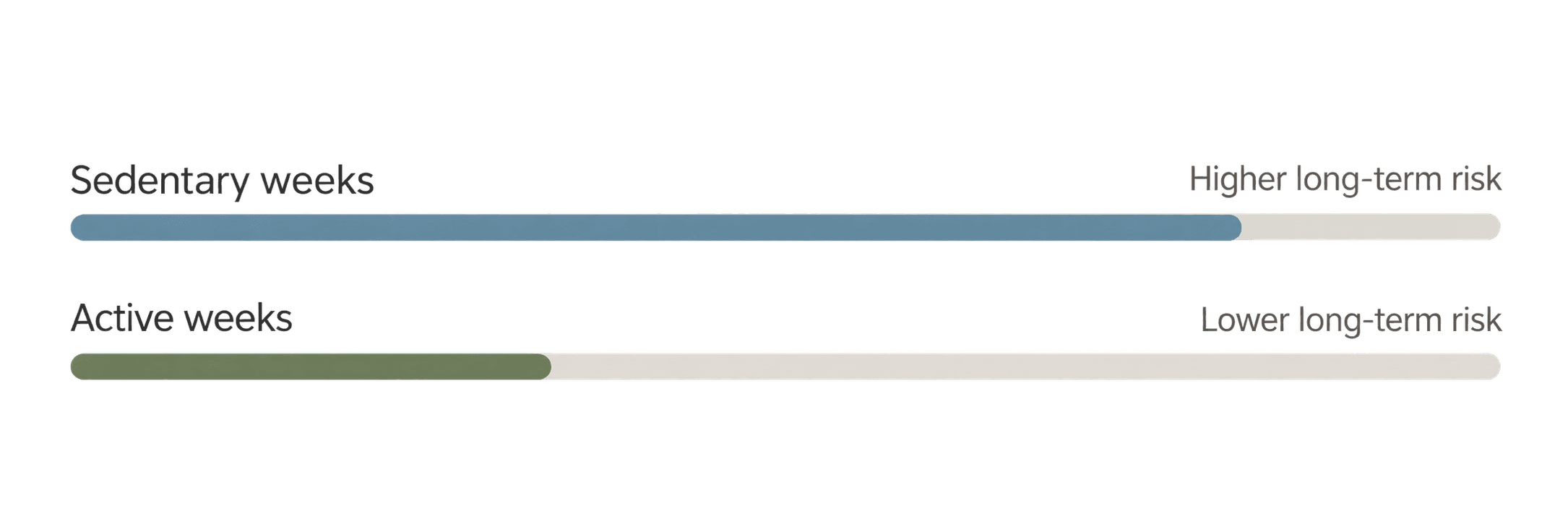
Illustrative, not clinical data — the direction is well established: consistent movement measurably lowers the long-term risks described above, even without extreme training.
Worth Knowing
It sounds small and unglamorous. The research says otherwise.
of hip fracture patients die within a year of the fracture — usually from what follows it, not the break itself.
higher one-year mortality risk seen in hip fracture patients with weak grip strength vs. strong grip, across multiple studies.
is when grip and muscle strength can start quietly declining — well before it ever becomes an "elderly" problem.
A strong grip is a strong predictor — not a coincidence
Weak grip strength is consistently linked to a higher risk of falling and of fracturing a hip when a fall happens, and to poorer recovery afterward. Building it now is prevention, not repair.
It gets harder after 50, not easier
The rate of muscle, bone, and grip decline doesn't stay flat with age — it steepens again past 50, which is exactly why fall and fracture risk climbs so sharply from here on. The lifestyle habits that were optional at 40 become the difference between staying capable and losing ground fast. Starting now is easier than starting later; every year of delay makes the rebuild harder.
Build It
Dead hangs
20–30 sec, 2–3x/week
Farmer's carries
Establishing your baseline
Breathwork calms the body. These train the mind. Best used together.
Morning resting heart rate
Take it first thing — before coffee, phone, or getting out of bed.
Count your pulse for 60 seconds, or use a tracker.
Record it. A noticeably elevated number vs. your own normal can flag poor sleep, stress, or overtraining.
Re-check every Sunday to see your trend.
Grip strength check
Use a hand-grip dynamometer if you have one.
No dynamometer? Time a dead hang from a bar instead.
Record today's number or time.
Re-test at Week 4 to see real movement.
Visualization & meditation
Breathwork calms the body. These train the mind. Best used together.
Visualization — 5 min
Sit comfortably, eyes closed, three slow breaths to settle.
Picture your day going exactly as you want — calm, clear, present.
Notice how that feels in your body, and let it anchor you.
Meditation — 5–10 min
Sit quietly, eyes closed or softly open.
Focus attention on the breath — just noticing, not controlling.
When the mind wanders, gently return. That return is the practice.
Shift the everyday default toward whole foods; keep packaged meals the occasional exception, not the rule.
Choose fragrance-free or simpler-ingredient products, and air out rooms after cleaning.
Swap food storage and water bottles to glass or stainless steel — a simple, one-time change.
No credible link to disease — but natural fibers breathe better and shed fewer microplastics than polyester.
The Blunt Version
FLOW LIFESTYLES
A gentle, whole-person approach to moving well, feeling clear, and living in rhythm with what matters.